Lightricks
Lightricks/LTX-2
Developed by: Lightricks - Model type: Diffusion-based audio-video foundation model - Language(s): English...
Model Documentation
LTX-2 Model Card
This model card focuses on the LTX-2 model, as presented in the paper LTX-2: Efficient Joint Audio-Visual Foundation Model. The codebase is available here.
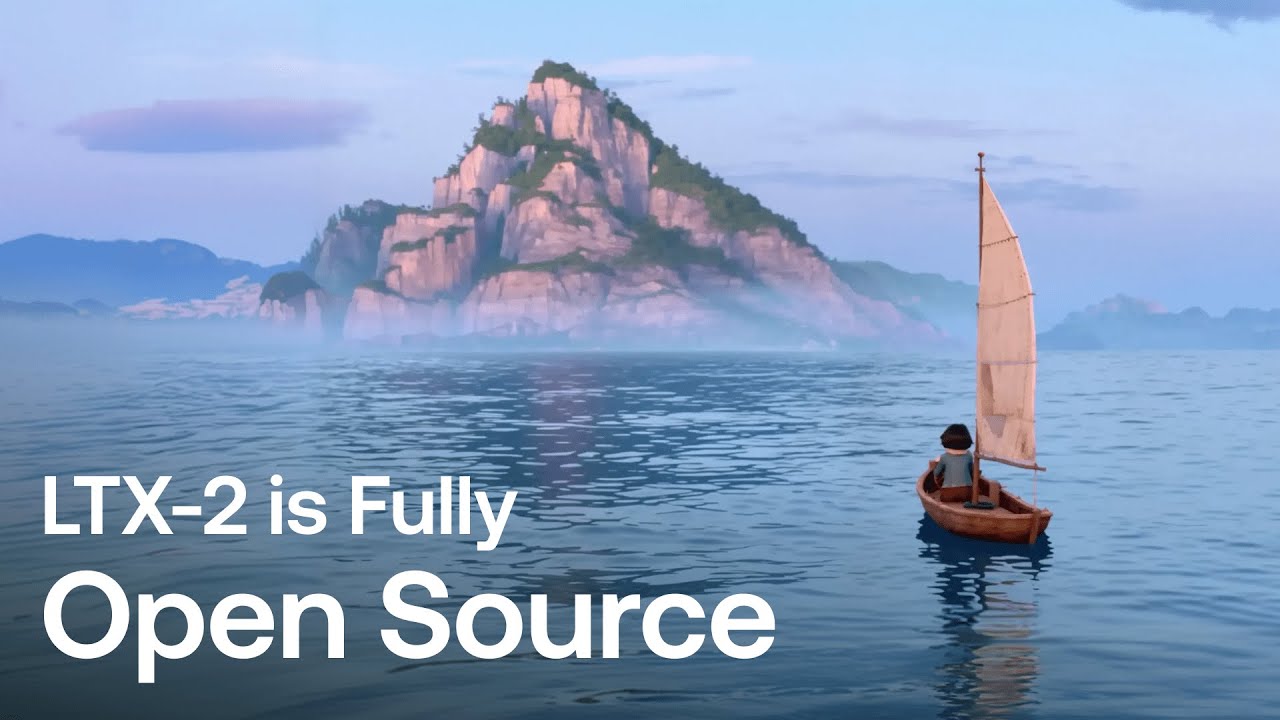
LTX-2 is a DiT-based audio-video foundation model designed to generate synchronized video and audio within a single model. It brings together the core building blocks of modern video generation, with open weights and a focus on practical, local execution.
Model Checkpoints
| Name | Notes | |--------------------------------|----------------------------------------------------------------------------------------------------------------| | ltx-2-19b-dev | The full model, flexible and trainable in bf16 | | ltx-2-19b-dev-fp8 | The full model in fp8 quantization | | ltx-2-19b-dev-fp4 | The full model in nvfp4 quantization | | ltx-2-19b-distilled | The distilled version of the full model, 8 steps, CFG=1 | | ltx-2-19b-distilled-lora-384 | A LoRA version of the distilled model applicable to the full model | | ltx-2-spatial-upscaler-x2-1.0 | An x2 spatial upscaler for the ltx-2 latents, used in multi stage (multiscale) pipelines for higher resolution | | ltx-2-temporal-upscaler-x2-1.0 | An x2 temporal upscaler for the ltx-2 latents, used in multi stage (multiscale) pipelines for higher FPS |
Model Details
Online demo
LTX-2 is accessible right away via the following links:Run locally
Direct use license
You can use the modelsComfyUI
We recommend you use the built-in LTXVideo nodes that can be found in the ComfyUI Manager. For manual installation information, please refer to our documentation site.PyTorch codebase
The LTX-2 codebase is a monorepo with several packages. From model definition in 'ltx-core' to pipelines in 'ltx-pipelines' and training capabilities in 'ltx-trainer'. The codebase was tested with Python >=3.12, CUDA version >12.7, and supports PyTorch ~= 2.7.
Installation
bash
git clone https://github.com/Lightricks/LTX-2.git
cd LTX-2

From the repository root
uv sync
source .venv/bin/activate
Inference
To use our model, please follow the instructions in our ltx-pipelines package.
Diffusers 🧨
LTX-2 is supported in the Diffusers Python library for text & image-to-video generation. Read more on LTX-2 with diffusers here.
Use with diffusers
To achieve production quality generation, it's recommended to use the two-stage generation pipeline. Example for 2-stage inference of text-to-video:python
import torch
from diffusers import FlowMatchEulerDiscreteScheduler
from diffusers.pipelines.ltx2 import LTX2Pipeline, LTX2LatentUpsamplePipeline
from diffusers.pipelines.ltx2.latent_upsampler import LTX2LatentUpsamplerModel
from diffusers.pipelines.ltx2.utils import STAGE_2_DISTILLED_SIGMA_VALUES
from diffusers.pipelines.ltx2.export_utils import encode_video
device = "cuda:0"
width = 768
height = 512
pipe = LTX2Pipeline.from_pretrained(
"Lightricks/LTX-2", torch_dtype=torch.bfloat16
)
pipe.enable_sequential_cpu_offload(device=device)
prompt = "A beautiful sunset over the ocean"
negative_prompt = "shaky, glitchy, low quality, worst quality, deformed, distorted, disfigured, motion smear, motion artifacts, fused fingers, bad anatomy, weird hand, ugly, transition, static."
Stage 1 default (non-distilled) inference
frame_rate = 24.0
video_latent, audio_latent = pipe(
prompt=prompt,
negative_prompt=negative_prompt,
width=width,
height=height,
num_frames=121,
frame_rate=frame_rate,
num_inference_steps=40,
sigmas=None,
guidance_scale=4.0,
output_type="latent",
return_dict=False,
)
latent_upsampler = LTX2LatentUpsamplerModel.from_pretrained(
"Lightricks/LTX-2",
subfolder="latent_upsampler",
torch_dtype=torch.bfloat16,
)
upsample_pipe = LTX2LatentUpsamplePipeline(vae=pipe.vae, latent_upsampler=latent_upsampler)
upsample_pipe.enable_model_cpu_offload(device=device)
upscaled_video_latent = upsample_pipe(
latents=video_latent,
output_type="latent",
return_dict=False,
)[0]
Load Stage 2 distilled LoRA
pipe.load_lora_weights(
"Lightricks/LTX-2", adapter_name="stage_2_distilled", weight_name="ltx-2-19b-distilled-lora-384.safetensors"
)
pipe.set_adapters("stage_2_distilled", 1.0)
VAE tiling is usually necessary to avoid OOM error when VAE decoding
pipe.vae.enable_tiling()
Change scheduler to use Stage 2 distilled sigmas as is
new_scheduler = FlowMatchEulerDiscreteScheduler.from_config(
pipe.scheduler.config, use_dynamic_shifting=False, shift_terminal=None
)
pipe.scheduler = new_scheduler
Stage 2 inference with distilled LoRA and sigmas
video, audio = pipe(
latents=upscaled_video_latent,
audio_latents=audio_latent,
prompt=prompt,
negative_prompt=negative_prompt,
num_inference_steps=3,
noise_scale=STAGE_2_DISTILLED_SIGMA_VALUES[0], renoise with first sigma value https://github.com/Lightricks/LTX-2/blob/main/packages/ltx-pipelines/src/ltx_pipelines/ti2vid_two_stages.py#L218
sigmas=STAGE_2_DISTILLED_SIGMA_VALUES,
guidance_scale=1.0,
output_type="np",
return_dict=False,
)
encode_video(
video[0],
fps=frame_rate,
audio=audio[0].float().cpu(),
audio_sample_rate=pipe.vocoder.config.output_sampling_rate,
output_path="ltx2_lora_distilled_sample.mp4",
)
General tips:
* Width & height settings must be divisible by 32. Frame count must be divisible by 8 + 1. * In case the resolution or number of frames are not divisible by 32 or 8 + 1, the input should be padded with -1 and then cropped to the desired resolution and number of frames. * For tips on writing effective prompts, please visit our Prompting guideLimitations
Train the model
The base (dev) model is fully trainable.
It's extremely easy to reproduce the LoRAs and IC-LoRAs we publish with the model by following the instructions on the LTX-2 Trainer Readme.
Training for motion, style or likeness (sound+appearance) can take less than an hour in many settings.
Citation
bibtex
@article{hacohen2025ltx2,
  title={LTX-2: Efficient Joint Audio-Visual Foundation Model},
  author={HaCohen, Yoav and Brazowski, Benny and Chiprut, Nisan and Bitterman, Yaki and Kvochko, Andrew and Berkowitz, Avishai and Shalem, Daniel and Lifschitz, Daphna and Moshe, Dudu and Porat, Eitan and Richardson, Eitan and Guy Shiran and Itay Chachy and Jonathan Chetboun and Michael Finkelson and Michael Kupchick and Nir Zabari and Nitzan Guetta and Noa Kotler and Ofir Bibi and Ori Gordon and Poriya Panet and Roi Benita and Shahar Armon and Victor Kulikov and Yaron Inger and Yonatan Shiftan and Zeev Melumian and Zeev Farbman},
  journal={arXiv preprint arXiv:2601.03233},
  year={2025}
}
Files & Weights
| Filename | Size | Action |
|---|---|---|
| ltx-2-19b-dev-fp4.safetensors | 18.62 GB | |
| ltx-2-19b-dev-fp8.safetensors | 25.22 GB | |
| ltx-2-19b-dev.safetensors | 40.31 GB | |
| ltx-2-19b-distilled-fp8.safetensors | 25.22 GB | |
| ltx-2-19b-distilled-lora-384.safetensors | 7.15 GB | |
| ltx-2-19b-distilled.safetensors | 40.31 GB | |
| ltx-2-spatial-upscaler-x2-1.0.safetensors | 0.93 GB | |
| ltx-2-temporal-upscaler-x2-1.0.safetensors | 0.24 GB |