Qwen
Qwen/Qwen3-Next-80B-A3B-Instruct-FP8
> [!Note] > Qwen3-Next-80B-A3B-Instruct-FP8 supports only instruct (non-thinking) mode and does not generate ```` blocks in its output. This...
Model Documentation
Qwen3-Next-80B-A3B-Instruct-FP8

Over the past few months, we have observed increasingly clear trends toward scaling both total parameters and context lengths in the pursuit of more powerful and agentic artificial intelligence (AI). We are excited to share our latest advancements in addressing these demands, centered on improving scaling efficiency through innovative model architecture. We call this next-generation foundation models Qwen3-Next.
> [!Note] > This repository contains the FP8-quantized Qwen3-Next-80B-A3B-Instruct model checkpoint for convenience and performance. > The quantization method is "fine-grained fp8" quantization with block size of 128. > You can find more details in the
quantization_config field in config.json.
>
> In addition, the experimental results presented in this model card are obtained from the original bfloat16 model prior to FP8 quantization.Highlights
Qwen3-Next-80B-A3B-FP8 is the first installment in the Qwen3-Next series and features the following key enchancements:
We are seeing strong performance in terms of both parameter efficiency and inference speed for Qwen3-Next-80B-A3B:
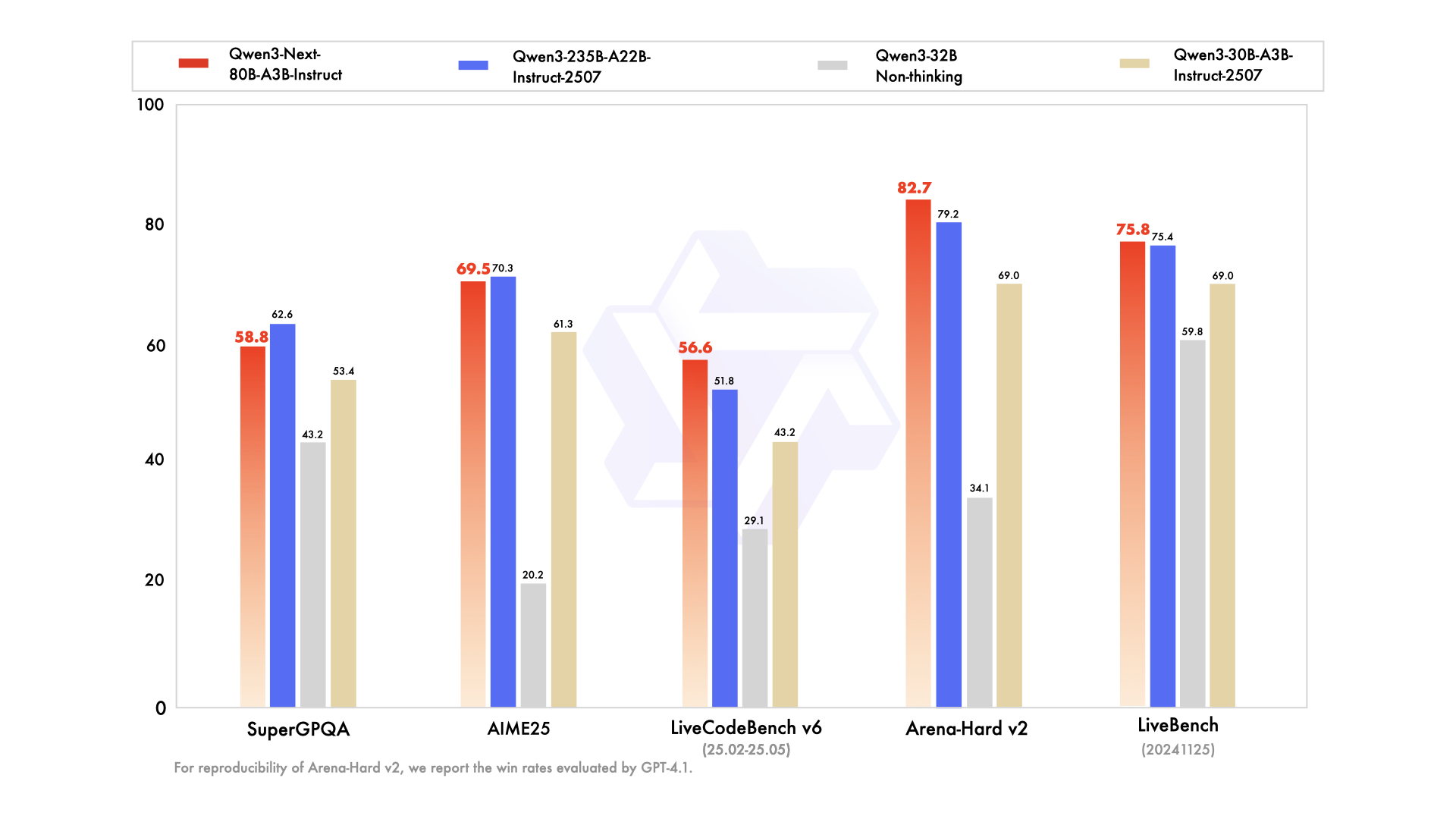
For more details, please refer to our blog post Qwen3-Next.
Model Overview
> [!Note] > Qwen3-Next-80B-A3B-Instruct-FP8 supports only instruct (non-thinking) mode and does not generate
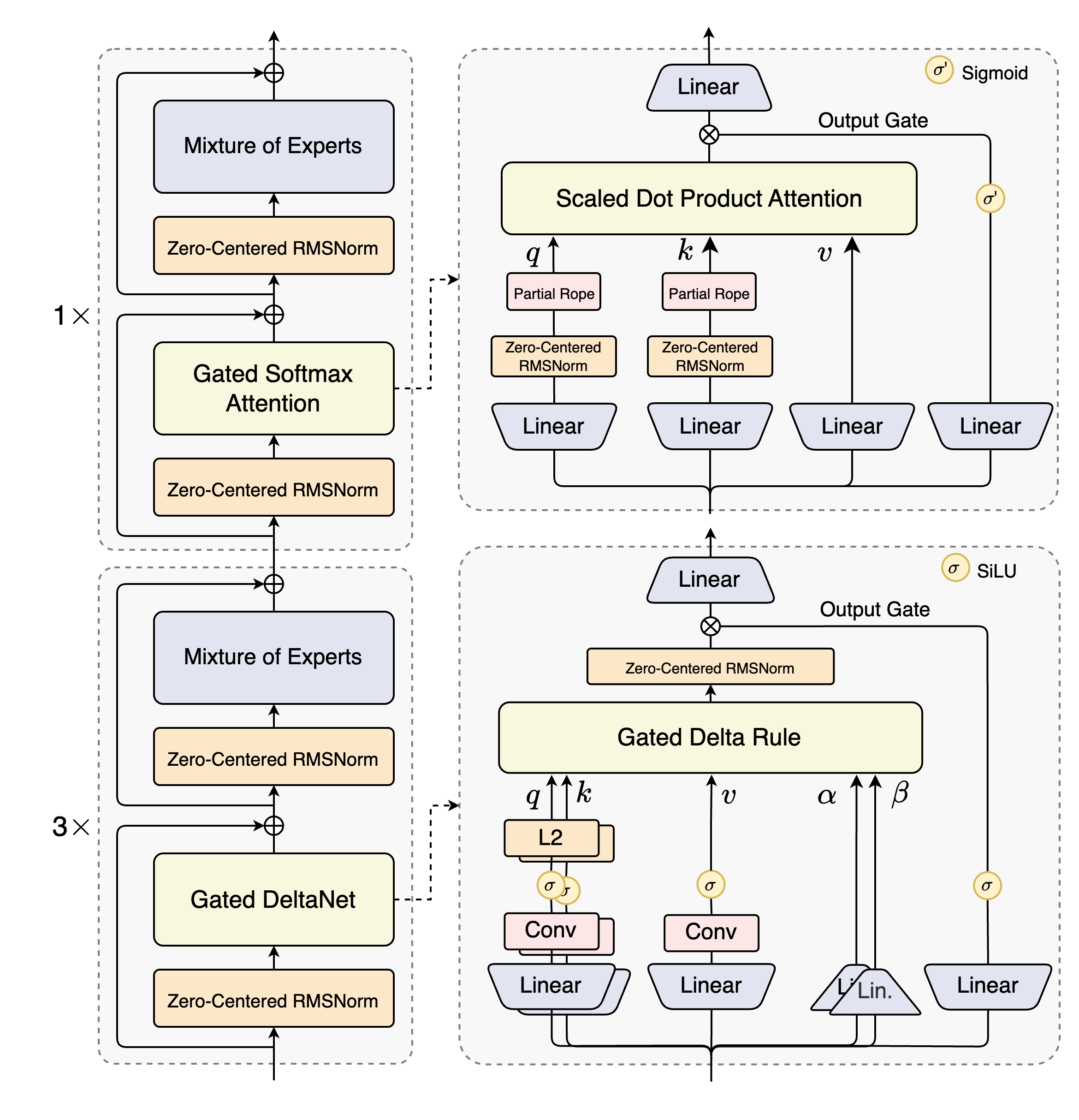
This repo contains the FP8 version of Qwen3-Next-80B-A3B-Instruct, which has the following features:
Performance
| | Qwen3-30B-A3B-Instruct-2507 | Qwen3-32B Non-Thinking | Qwen3-235B-A22B-Instruct-2507 | Qwen3-Next-80B-A3B-Instruct | |--
*: For reproducibility, we report the win rates evaluated by GPT-4.1.
Deployment
You can use Qwen3-Next-80B-A3B-Instruct-FP8 with serveral inference frameworks, including
sglang, and vllm, as the original bfloat16 model.
The following guide demonstrates how to serve Qwen3-Next-80B-A3B-Instruct-FP8 via an OpenAI-compatible API endpoint using the latest sglang or vllm.SGLang
SGLang is a fast serving framework for large language models and vision language models. SGLang could be used to launch a server with OpenAI-compatible API service.
The latest main of
sglang is required for Qwen3-Next-FP8, which can be installed using:
shell
pip install 'sglang[all] @ git+https://github.com/sgl-project/sglang.git@main'
The following command can be used to create an API endpoint at
http://localhost:30000/v1 with maximum context length 256K tokens using tensor parallel on 4 GPUs.
shell
python -m sglang.launch_server --model-path Qwen/Qwen3-Next-80B-A3B-Instruct-FP8 --port 30000 --tp-size 4 --context-length 262144 --mem-fraction-static 0.8
The following command is recommended for MTP with the rest settings the same as above:
shell
python -m sglang.launch_server --model-path Qwen/Qwen3-Next-80B-A3B-Instruct-FP8 --port 30000 --tp-size 4 --context-length 262144 --mem-fraction-static 0.8 --speculative-algo NEXTN --speculative-num-steps 3 --speculative-eagle-topk 1 --speculative-num-draft-tokens 4
> [!Note] > The default context length is 256K. Consider reducing the context length to a smaller value, e.g.,
32768, if the server fails to start.Please also refer to SGLang's usage guide on Qwen3-Next.
vLLM
vLLM is a high-throughput and memory-efficient inference and serving engine for LLMs. vLLM could be used to launch a server with OpenAI-compatible API service.
The latest main of
vllm is required for Qwen3-Next-FP8, which can be installed using:
shell
pip install vllm --pre --extra-index-url https://wheels.vllm.ai/nightly
The following command can be used to create an API endpoint at
http://localhost:8000/v1 with maximum context length 256K tokens using tensor parallel on 4 GPUs.
shell
vllm serve Qwen/Qwen3-Next-80B-A3B-Instruct-FP8 --port 8000 --tensor-parallel-size 4 --max-model-len 262144
The following command is recommended for MTP with the rest settings the same as above:
shell
vllm serve Qwen/Qwen3-Next-80B-A3B-Instruct-FP8 --port 8000 --tensor-parallel-size 4 --max-model-len 262144 --speculative-config '{"method":"qwen3_next_mtp","num_speculative_tokens":2}'
> [!Note] > The default context length is 256K. Consider reducing the context length to a smaller value, e.g.,
32768, if the server fails to start.Please also refer to vLLM's usage guide on Qwen3-Next.
Agentic Use
Qwen3 excels in tool calling capabilities. We recommend using Qwen-Agent to make the best use of agentic ability of Qwen3. Qwen-Agent encapsulates tool-calling templates and tool-calling parsers internally, greatly reducing coding complexity.
To define the available tools, you can use the MCP configuration file, use the integrated tool of Qwen-Agent, or integrate other tools by yourself.
python
from qwen_agent.agents import Assistant

Define LLM
llm_cfg = {
    'model': 'Qwen3-Next-80B-A3B-Instruct-FP8',

    Use a custom endpoint compatible with OpenAI API:
    'model_server': 'http://localhost:8000/v1',  api_base
    'api_key': 'EMPTY',
}

Define Tools
tools = [
    {'mcpServers': {  You can specify the MCP configuration file
            'time': {
                'command': 'uvx',
                'args': ['mcp-server-time', '--local-timezone=Asia/Shanghai']
            },
            "fetch": {
                "command": "uvx",
                "args": ["mcp-server-fetch"]
            }
        }
    },
  'code_interpreter',  Built-in tools
]

Define Agent
bot = Assistant(llm=llm_cfg, function_list=tools)

Streaming generation
messages = [{'role': 'user', 'content': 'https://qwenlm.github.io/blog/ Introduce the latest developments of Qwen'}]
for responses in bot.run(messages=messages):
    pass
print(responses)
Processing Ultra-Long Texts
Qwen3-Next natively supports context lengths of up to 262,144 tokens. For conversations where the total length (including both input and output) significantly exceeds this limit, we recommend using RoPE scaling techniques to handle long texts effectively. We have validated the model's performance on context lengths of up to 1 million tokens using the YaRN method.
YaRN is currently supported by several inference frameworks, e.g.,
transformers, vllm and sglang.
In general, there are two approaches to enabling YaRN for supported frameworks:config.json file, add the rope_scaling fields:
json
    {
        ...,
        "rope_scaling": {
            "rope_type": "yarn",
            "factor": 4.0,
            "original_max_position_embeddings": 262144
        }
    }
For
vllm, you can use
shell
    VLLM_ALLOW_LONG_MAX_MODEL_LEN=1 vllm serve ... --rope-scaling '{"rope_type":"yarn","factor":4.0,"original_max_position_embeddings":262144}' --max-model-len 1010000
For
sglang, you can use
shell
    SGLANG_ALLOW_OVERWRITE_LONGER_CONTEXT_LEN=1 python -m sglang.launch_server ... --json-model-override-args '{"rope_scaling":{"rope_type":"yarn","factor":4.0,"original_max_position_embeddings":262144}}' --context-length 1010000
> [!NOTE] > All the notable open-source frameworks implement static YaRN, which means the scaling factor remains constant regardless of input length, potentially impacting performance on shorter texts. > We advise adding the
rope_scaling configuration only when processing long contexts is required.
> It is also recommended to modify the factor as needed. For example, if the typical context length for your application is 524,288 tokens, it would be better to set factor as 2.0. #
Long-Context Performance
We test the model on an 1M version of the RULER benchmark.
| Model Name | Acc avg | 4k | 8k | 16k | 32k | 64k | 96k | 128k | 192k | 256k | 384k | 512k | 640k | 768k | 896k | 1000k | |---------------------------------------------|---------|------|------|------|------|------|------|------|------|------|------|------|------|------|------|-------| | Qwen3-30B-A3B-Instruct-2507 | 86.8 | 98.0 | 96.7 | 96.9 | 97.2 | 93.4 | 91.0 | 89.1 | 89.8 | 82.5 | 83.6 | 78.4 | 79.7 | 77.6 | 75.7 | 72.8 | | Qwen3-235B-A22B-Instruct-2507 | 92.5 | 98.5 | 97.6 | 96.9 | 97.3 | 95.8 | 94.9 | 93.9 | 94.5 | 91.0 | 92.2 | 90.9 | 87.8 | 84.8 | 86.5 | 84.5 | | Qwen3-Next-80B-A3B-Instruct | 91.8 | 98.5 | 99.0 | 98.0 | 98.7 | 97.6 | 95.0 | 96.0 | 94.0 | 93.5 | 91.7 | 86.9 | 85.5 | 81.7 | 80.3 | 80.3 |
* Qwen3-Next are evaluated with YaRN enabled. Qwen3-2507 models are evaluated with Dual Chunk Attention enabled. * Since the evaluation is time-consuming, we use 260 samples for each length (13 sub-tasks, 20 samples for each).
Best Practices
To achieve optimal performance, we recommend the following settings:
1. Sampling Parameters:
Temperature=0.7, TopP=0.8, TopK=20, and MinP=0.presence_penalty parameter between 0 and 2 to reduce endless repetitions. However, using a higher value may occasionally result in language mixing and a slight decrease in model performance.2. Adequate Output Length: We recommend using an output length of 16,384 tokens for most queries, which is adequate for instruct models.
3. Standardize Output Format: We recommend using prompts to standardize model outputs when benchmarking.
answer field with only the choice letter, e.g., "answer": "C"."Citation
If you find our work helpful, feel free to give us a cite.
@misc{qwen3technicalreport,
      title={Qwen3 Technical Report},
      author={Qwen Team},
      year={2025},
      eprint={2505.09388},
      archivePrefix={arXiv},
      primaryClass={cs.CL},
      url={https://arxiv.org/abs/2505.09388},
}

@article{qwen2.5-1m,
      title={Qwen2.5-1M Technical Report},
      author={An Yang and Bowen Yu and Chengyuan Li and Dayiheng Liu and Fei Huang and Haoyan Huang and Jiandong Jiang and Jianhong Tu and Jianwei Zhang and Jingren Zhou and Junyang Lin and Kai Dang and Kexin Yang and Le Yu and Mei Li and Minmin Sun and Qin Zhu and Rui Men and Tao He and Weijia Xu and Wenbiao Yin and Wenyuan Yu and Xiafei Qiu and Xingzhang Ren and Xinlong Yang and Yong Li and Zhiying Xu and Zipeng Zhang},
      journal={arXiv preprint arXiv:2501.15383},
      year={2025}
}
Files & Weights
| Filename | Size | Action |
|---|---|---|
| model-00001-of-00008.safetensors | 10.00 GB | |
| model-00002-of-00008.safetensors | 10.00 GB | |
| model-00003-of-00008.safetensors | 10.00 GB | |
| model-00004-of-00008.safetensors | 10.00 GB | |
| model-00005-of-00008.safetensors | 10.00 GB | |
| model-00006-of-00008.safetensors | 10.00 GB | |
| model-00007-of-00008.safetensors | 10.00 GB | |
| model-00008-of-00008.safetensors | 6.41 GB |