bigscience
bigscience/bloom-560m
No description available.
Model Documentation
BLOOM LM
BigScience Large Open-science Open-access Multilingual Language Model
Model Card

Version 1.0 / 26.May.2022
Model Card for Bloom-560m
Provide a quick summary of what the model is/does. -->
Table of Contents
1. Model Details 2. Uses 3. Bias, Risks, and Limitations 4. Recommendations 5. Training Data 6. Evaluation 7. Environmental Impact 8. Technical Specifications 9. Citation 10. Glossary and Calculations 11. More Information 12. Model Card Authors 13. Model Card ContactModel Details
Model Description
*This section provides information for anyone who wants to know about the model.** All collaborators are either volunteers or have an agreement with their employer. *(Further breakdown of participants forthcoming.)*
* Hugging Face (website).
* Organizations of contributors. *(Further breakdown of organizations forthcoming.)*
Uses
*This section addresses questions around how the model is intended to be used, discusses the foreseeable users of the model (including those affected by the model), and describes uses that are considered out of scope or misuse of the model. It provides information for anyone considering using the model or who is affected by the model.*
Intended Use
This model is being created in order to enable public research on large language models (LLMs). LLMs are intended to be used for language generation or as a pretrained base model that can be further fine-tuned for specific tasks. Use cases below are not exhaustive.
#
Direct Use
#
Downstream Use
Misuse and Out-of-scope Use
*This section addresses what users ought not do with the model.*See the BLOOM License, Attachment A, for detailed usage restrictions. The below list is non-exhaustive, but lists some easily foreseeable problematic use cases.
#
Out-of-scope Uses
Using the model in high-stakes settings is out of scope for this model. The model is not designed for critical decisions nor uses with any material consequences on an individual's livelihood or wellbeing. The model outputs content that appears factual but is not correct.
##
Out-of-scope Uses Include:
#
Misuse
Intentionally using the model for harm, violating human rights, or other kinds of malicious activities, is a misuse of this model. This includes:
Intended Users
#
Direct Users
#
Indirect Users
#
Others Affected (Parties Prenantes)
Bias, Risks and Limitations
*This section identifies foreseeable harms and misunderstandings.*Model may:
Recommendations
*This section provides information on warnings and potential mitigations.*
Training Data
*This section provides a high-level overview of the training data. It is relevant for anyone who wants to know the basics of what the model is learning.*Details for each dataset are provided in individual Data Cards.
Training data includes:
#
Languages
The pie chart shows the distribution of languages in training data.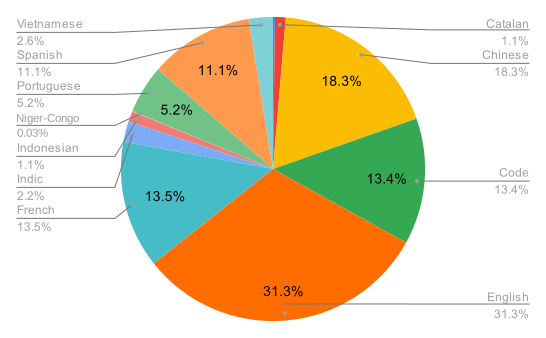
The following table shows the further distribution of Niger-Congo and Indic languages in the training data. | Niger Congo | Percentage | | Indic | Percentage | |----------------|-----------
The following table shows the distribution of programming languages.
| Extension | Language | Number of files | |----------------|------------|-----------------| | java | Java | 5,407,724 | | php | PHP | 4,942,186 | | cpp | C++ | 2,503,930 | | py | Python | 2,435,072 | | js | JavaScript | 1,905,518 | | cs | C
| 1,577,347 |
| rb | Ruby | 6,78,413 | | cc | C++ | 443,054 | | hpp | C++ | 391,048 | | lua | Lua | 352,317 | | go | GO | 227,763 | | ts | TypeScript | 195,254 | | C | C | 134,537 | | scala | Scala | 92,052 | | hh | C++ | 67,161 | | H | C++ | 55,899 | | tsx | TypeScript | 33,107 | | rs | Rust | 29,693 | | phpt | PHP | 9,702 | | c++ | C++ | 1,342 | | h++ | C++ | 791 | | php3 | PHP | 540 | | phps | PHP | 270 | | php5 | PHP | 166 | | php4 | PHP | 29 |Evaluation
*This section describes the evaluation protocols and provides the results.*Metrics
*This section describes the different ways performance is calculated and why.* Includes:| Metric | Why chosen | |--------------------|--------------------------------------------------------------------| | Perplexity | Standard metric for quantifying model improvements during training | | Cross Entropy Loss | Standard objective for language models. |
And multiple different metrics for specific tasks. _(More evaluation metrics forthcoming upon completion of evaluation protocol.)_
Factors
*This section lists some different aspects of what BLOOM models. Its focus is on those aspects that are likely to give rise to high variance in model behavior.*Results
*Results are based on the Factors and Metrics.*Train-time Evaluation:
As of 25.May.2022, 15:00 PST:
(More evaluation scores forthcoming at the end of model training.)
Environmental Impact
The training supercomputer, Jean Zay (website), uses mostly nuclear energy. The heat generated by it is reused for heating campus housing. Estimated carbon emissions: *(Forthcoming upon completion of training.)* Estimated electricity usage: *(Forthcoming upon completion of training.)*
Technical Specifications
*This section provides information for people who work on model development.*Please see the BLOOM training README for full details on replicating training.
Model Architecture: Modified from Megatron-LM GPT2 (see paper, BLOOM Megatron code):
* Decoder-only architecture
* Layer normalization applied to word embeddings layer (
StableEmbedding; see code, paper)* ALiBI positional encodings (see paper), with GeLU activation functions
* 559,214,592 parameters:
* 256,901,120 embedding parameters
* 24 layers, 16 attention heads
* Hidden layers are 1024-dimensional
* Sequence length of 2048 tokens (see BLOOM tokenizer, tokenizer description)
Objective Function: Cross Entropy with mean reduction (see API documentation). Compute infrastructure: Jean Zay Public Supercomputer, provided by the French government (see announcement).
* Hardware: 384 A100 80GB GPUs (48 nodes): * Additional 32 A100 80GB GPUs (4 nodes) in reserve
* 8 GPUs per node Using NVLink 4 inter-gpu connects, 4 OmniPath links
* CPU: AMD
* CPU memory: 512GB per node
* GPU memory: 640GB per node
* Inter-node connect: Omni-Path Architecture (OPA)
* NCCL-communications network: a fully dedicated subnet
* Disc IO network: shared network with other types of nodes
* Software: * Megatron-DeepSpeed (Github link)
* DeepSpeed (Github link)
* PyTorch (pytorch-1.11 w/ CUDA-11.5; see Github link)
* apex (Github link)
Training
Training logs: Tensorboard link
Tokenization
The BLOOM tokenizer (link) is a learned subword tokenizer trained using:It was trained on a subset of a preliminary version of the corpus using alpha-weighting per language.
Citation
Cite as: BigScience, _BigScience Language Open-science Open-access Multilingual (BLOOM) Language Model_. International, May 2021-May 2022
Glossary and Calculations
*This section defines common terms and how metrics are calculated.*
More Information
Dataset Creation
Blog post detailing the design choices during the dataset creation: https://bigscience.huggingface.co/blog/building-a-tb-scale-multilingual-dataset-for-language-modeling
Technical Specifications
Blog post summarizing how the architecture, size, shape, and pre-training duration where selected: https://bigscience.huggingface.co/blog/what-language-model-to-train-if-you-have-two-million-gpu-hours
More details on the architecture/optimizer: https://github.com/bigscience-workshop/bigscience/tree/master/train/tr11-176B-ml
Blog post on the hardware/engineering side: https://bigscience.huggingface.co/blog/which-hardware-to-train-a-176b-parameters-model
Details on the distributed setup used for the training: https://github.com/bigscience-workshop/bigscience/tree/master/train/tr11-176B-ml
Tensorboard updated during the training: https://huggingface.co/bigscience/tr11-176B-ml-logs/tensorboard#scalars&tagFilter=loss
Insights on how to approach training, negative results: https://github.com/bigscience-workshop/bigscience/blob/master/train/lessons-learned.md
Details on the obstacles overcome during the preparation on the engineering side (instabilities, optimization of training throughput, so many technical tricks and questions): https://github.com/bigscience-workshop/bigscience/blob/master/train/tr11-176B-ml/chronicles.md
Initial Results
Initial prompting experiments using interim checkpoints: https://huggingface.co/spaces/bigscience/bloom-book
Model Card Authors
*Ordered roughly chronologically and by amount of time spent.*Margaret Mitchell, Giada Pistilli, Yacine Jernite, Ezinwanne Ozoani, Marissa Gerchick, Nazneen Rajani, Sasha Luccioni, Irene Solaiman, Maraim Masoud, Somaieh Nikpoor, Carlos Muñoz Ferrandis, Stas Bekman, Christopher Akiki, Danish Contractor, David Lansky, Angelina McMillan-Major, Tristan Thrush, Suzana Ilić, Gérard Dupont, Shayne Longpre, Manan Dey, Stella Biderman, Douwe Kiela, Emi Baylor, Teven Le Scao, Aaron Gokaslan, Julien Launay, Niklas Muennighoff
Model Card Contact
Send Questions to: bigscience-contact@googlegroups.com
Files & Weights
| Filename | Size | Action |
|---|---|---|
| flax_model.msgpack | 1.04 GB | |
| model.safetensors | 1.04 GB | |
| pytorch_model.bin | 1.04 GB |